
Table of Contents
Swarming Season: Where & When
FAQ-Do termites in my home mean I have an infestation?
Termite Types & Species
FAQ-What’s the difference between flying ants and termites?
Does Homeowners Insurance Cover Termite Damage?
Termites: “The Other Natural Disaster”
Prevention: Keep termites out & away
FAQ-How much does termite treatment cost?
How to Look for Termite Damage
FAQ-Can you hear termites in the wall?
Termite Control – How to rid your home of termites
FAQ-What kills termites?
. . . . . . . . . . . . . . . . . . . . . . .
Termite Swarming Season – Where & When
Although it depends upon the particular species, the presence and age of colonies in a specific place (such as a city block or neighborhood), and the seasonal temperature of a region – In general, areas in the U.S. where the most termite activity occurs typically see swarms in the “Spring” – or, since that can also vary from location to location – swarms begin when warm weather begins.
This doesn’t mean that termite swarms, nor termite infestations are limited to the months of April, May, or June – in some locations, termite swarms can begin in February or take place as late as November. Further, and perhaps more importantly, a termite swarm should not be viewed as the start and end of the presence of termites – without regular inspections, most termite infestations continue for years often detected by homeowners.

In fact, in some ways, a termite swarm can be viewed as an almost definite indication that termites are present on your property, or on nearby property that is close enough to bring an infestation close to home (or, inside your home). This is because termites only swarm when a colony matures, a process that on average takes about three years. So, if you’re seeing swarms in your neighborhood or on the exterior/interior of your home (near window sills, etc.) – this is a strong sign that colonies are looking to spread in your neck of the woods (sorta literally).

FAQ-Do termites in my home mean I have an infestation?
Mature colonies can be anywhere from three to six years old (or older), contain anywhere from thousands to more than a million termites, and may produce winged “swarmers” (or, reproductive termites called “alates”) each year. That’s a lot of termites flying around to find a new place to reproduce more termites to, eventually, move around and produce more termites.
So – Where are the most termites?
Regardless of species, termites not only favor warm weather – they need it. This is why the only state in the U.S. that is entirely termite-free is Alaska. Termites also require wet conditions to survive, which is why the damp, warm southeastern states of the U.S. provide the most hospitable termite habitats.
In alphabetical order, the 10 states with the most termites (along with termite damage), are:
Alabama
Arkansas
California
Florida
Georgia
Louisiana
Mississippi
North Carolina
South Carolina
Texas

As you can see, the risk of termite infestation lessens along with regional climate/heat. It’s also true, that with warmer temperatures and wetter conditions, comes a larger variety/amount of termite types and species.
Termite Types & Species
In general, there are three types of termites in the United States:
Drywood Termites
Dampwood Termites
Subterranean Termites
Drywood termites build their nests in “sound” (little to no rot) dry wood above ground. Although they can cause significant damage, drywood termites are mostly confined to Atlantic coastal states south of Virginia (see: top 10 list above), to the whole state of Florida (Atlantic & Gulf Coasts), to states along the Gulf Coast and the Mexican border, and in portions of the Pacific Coast (where it’s warm and wet).
Dampwood termites make their nests in moist, decaying wood, but can extend their tunnels into drier wood. Dampwood termites are relatively minor structural pests, and are limited to the Pacific Coast, the Southwest desert, southern Florida, and Hawaii (which, contrary to termite-free Alaska, has the misfortune of experiencing problems with all three types of termites).
This brings us to the subterranean termite.
(pause for dramatic effect).
The subterranean termite is the most destructive termite of the three – causing billions of dollars in structural damage in the U.S. each year.
Subterranean termites typically dwell and nest in soil, which is also what they use to construct pathways to wood above. These shelter tubes, commonly called mud tubes, are a sort-of termite superhighway, carrying termites from the moist protection of their underground lairs to their food source above (wood – such as support beams or the floorboards of your home). The vast majority of damage, loss, and associated costs incurred from termites in the United States is caused by subterranean termite species.

Subterranean Termites – “Native” & “Invasive”
Although it might seem intuitive to consider any & all termites that make their way into your home “invasive,” subterranean termites can be broken down into those that have always been in the U.S. (native) and those that were brought into the U.S. (invasive).
Of the subterranean termites native to the U.S., the most common species is the Eastern subterranean termite. Eastern subterranean “swarming” termites are typically dark brown or black, with “long” wings (relatively long to the proportion of their bodies) – an appearance that sometimes causes people to confuse them with flying ants.
FAQ-What’s the difference between flying ants and termites?
“Invasive” subterranean termites – in this case, Formosan termites, have also been mistaken for flying ants when swarming in their winged form, even though the bodies of Formosans are a lighter yellow-brown color.
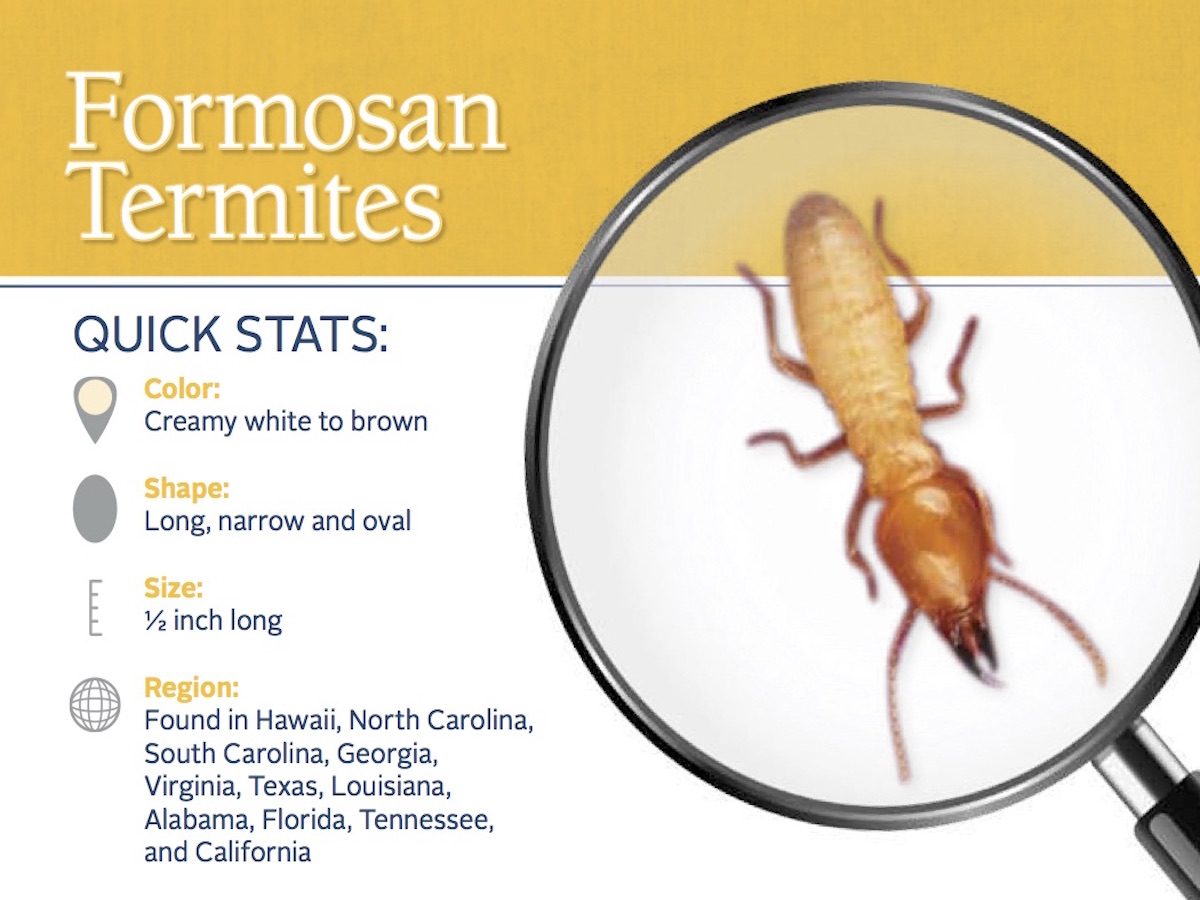
In addition to encountering the same case of mistaken identity, the eastern subterranean termite and Formosan subterranean termite share quite a bit in common. Both live in nests beneath the dirt and use mud tubes to travel above ground (possibly to eat your home).
In both cases, their nests can contain a million termites or more.
And within these nests, or colonies, exists the same “caste system” common to all termites – At the top, the only two members of the colony’s reproductive caste, the termite king and queen (who can produce one egg every three seconds, or about 30,000 eggs per day), next in the hierarchy are the soldiers, who, despite using their size and defense features (strong jaws, and in some cases, the ability to shoot chemicals out of their head) to protect the colony, these soldiers are otherwise incapable of caring for themselves. This is where the lowest caste, the workers, fits in – as the colony members that are smallest in size, but largest in number and carrying the biggest “caseload” (which includes feeding on house wood to bring back as food for the queen, who hopefully gets to grab a bite in-between and independent of egg-laying every three seconds).

Between the two species, soldier termites have distinctive features that distinguish eastern subterraneans from Formosans. For the most part, however, the legions of eastern subterranean and Formosan subterranean workers look alike (small, white, and quite numerous when there’s an infestation present).
WATCH: Eastern Subterranean Termite VS Formosan Termite (What’s the Difference – Termites)
Both species also need water, and warmth.
That said, the eastern subterranean termite finds warmth in more locations – inhabiting every state (with the exception of termite-free Alaska, of course), whereas Formosan termites are localized almost solely to the southern U.S.
Don’t let the greater geographic expanse of eastern subterranean termites mislead you, however. Covering more (under)ground, doesn’t translate into doing more damage
Although the types of damages caused by both subterranean species are similar (for example, eating your roof beams & rafters), the extent of damage each species inflicts differs somewhat drastically.
Formosan termites have larger colonies, are more aggressive in attacking buildings, and can cause more damage in less time (this is why some have dubbed the species, “super termite”). With about 2 million termites working in the right conditions (potentially two colonies near one home – not that uncommon), Formosan subterranean termites can “total” a home (create damages that exceed its value) within a year or two.
WATCH: “New Orleans termites eat a tiny house from the inside out”
Will Homeowners Insurance Pay for Termite Damages?
Simply Put: No.
Well, more accurately put – very rarely.
insurance.
Footing the Bill – Other Considerations: In addition to potentially having to pay for costly repairs to the home you live in, if you own that home, there is also the potential issue of future resale value. Termite damage to your home can significantly lower its selling price, and in some cases, slow or stop the sale of your residence altogether.
Termites: “The Other Natural Disaster”
Un-insurable, and astronomically costly – termite damage accounts for $5 billion dollars in structural home damages every year in the United States ($40 billion worldwide).
It is estimated that annually more than 600,000 U.S. homes are damaged by termites. Putting that into perspective, that’s about three times the amount of homes in New Orleans, and considering that termite damages are underreported, that’s near the amount of homes in Houston, TX — in this way, the combined number of homes with significant termite damage each year can be viewed as comparable to a major hurricane hitting a southern metropolitan city.
Not only do termite damages go underreported, they also go undiscovered.
In some cases, structural weaknesses caused by termite damage may not be discovered until a “typical” natural disaster, such as a hurricane, does strike a city or town, impacting homes in ways that reveal previous instability due to termite activity. The that termites create in structural supports of a home make it less likely to withstand high winds, debris, and water impacts – and, somewhat ironically, impacts from termite-infested trees…
…here, again, impact-enhancing damages caused by termites are likely overlooked or overshadowed in wake of natural disasters – another example of termite destruction going uncounted and unaccounted for.
And although numbers are important to record for research, and as a knowledge base from which to build back better and make policy or other improvements, a lack of recognition toward how termite damage contributes to repair costs, or even home loss, means that knowledge is likely not going to resonate with a home owner who could benefit from protecting against “The Other Natural Disaster” (termites) in the future.
Termite Prevention – Keep termites away & out of your home
The National Pest Management Association (NPMA) offers the following advice to prevent infestation / protect from termites:
- Eliminate or reduce moisture in and around the home, which termites need to thrive…
- Repair leaking faucets, water pipes and exterior AC units.
- Repair fascia, soffits and rotted roof shingles.
- Replace weather stripping and loose mortar around basement foundation and windows.
- Divert water away from the house through properly functioning downspouts, gutters and splash blocks.
- Routinely inspect the foundation of a home for signs of mud tubes (used by termites to reach a food source), uneven or bubbling paint and wood that sounds hollow when tapped.
- Monitor all exterior areas of wood, including windows, doorframes and skirting boards for any noticeable changes.
- Maintain an 18-inch gap between soil and any wood portions of your home.
- Consider scheduling a professional inspection annually – Wood-boring insect damage is not covered by homeowners insurance policies.
- Store firewood at least 20 feet away from the house.
Additionally, on a more short-term, daily basis (in particular when it’s swarm season in your region) be sure to turn off lights inside and outside your home when termites that are attracted to light (such as the Formosan) are swarming. Similarly, be sure to close your garage door (to keep all sorts of pests out), and keep windows & doors closed during swarms – and in general, check for cracks/gaps in your home’s foundation and make sure windows & other potential entryways are properly sealed (these are also areas to inspect regularly for signs of termite damage/presence).
Part of the reason you may see “schedule a professional inspection” suggested over and over – whether as a proactive (annual) move before termites are openly detected, or as a reactive measure to prevent further damage to your home – is because many professionals/professional services offer rather reasonably priced or even free initial inspections/consultations. Of course, should professional termite inspections, treatments, or other services become a regular practice you will have to pay an agreed upon price.
FAQ-How much does termite treatment cost?
But, as is the case with almost all home mitigation measures, the long-term savings from enlisting a professional to either perform preventative treatments or identify a termite problem and address it, FAR outweigh the alternative costly outcomes, and loss of what are sometimes irreplaceable places or sentimental items in your home…(See: “LAGNIAPPE” below the FAQ section at the end of this post for some stories about treasured locations and homes losing their battle with the formidable Formosan or other types of termites).
One thing is absolutely certain: Not making regular checks of your house and property, and/or ignoring signs of termite infestation & damage, does NOT mean the problem will simply go away – Remember! Colonies just keep growing, sometimes to more than a million termites, before multiplying the number of nests as well via those pesky swarmers, the winged reproductive explorers seeking to start & settle the next big colony. If you already have an infestation in your home, and on(below) your property, the chances of having nearby swarms that are successful in doubling and tripling the threat are quite high.
How to Look for Termite Damage
FAQ-Can you hear termites in the wall?
Termite Control – How to rid your home of termites
Should you find that a termite problem exists, here are three standard methods for treatment:
Soil Treatment – As subterranean termites live in soil, the surrounding soil is treated to act as a barrier. A trench is dug around the foundation, the soil is treated with a termiticide, then the trench is refilled. This helps to prevent future termite infestations and kills any termites in the house as they have to return to the soil to nest.
Wood Treatment – There are a variety of different wood treatments that help kill existing termite colonies and prevent future ones from forming. These treatments include surface sprays, injected sprays and foams, and borate-treated wood, which is also used in homes to avoid termite infestations. Preventative wood treatments include surface applications during the home building construction phrase and wood injections and foams after a house is built.
Bait Systems – Bait treatment systems are effective for destroying termite colonies. Bait stations are installed around the home’s perimeter and are monitored on a set frequency to make sure the house is protected from current and future infestations. (SOURCE – for, three methods)
SUMMATION VIDEO:
. . . . . . . . . . . . .
TERMITE FAQS
FAQ-Do termites in my home mean I have an infestation?
Termites work quietly inside walls, floors, and attics, and because of their secretive nature, a building can be infested for quite a long time before the problem is detected. And as established – termites are underground dwellers who, in some ways, can be viewed as sneaking around your property and into your home.
When it comes to the property surrounding your house, a single colony of Formosan subterranean termites can contain several million individual termites that are know to forage up to 300 feet in soil. This is party why a general rule you might hear about whether termites in your home indicate a definite infestation is: Maybe. But it’s almost certainly an indication that termites are present on your property, or nearby property (see: “foraging 300 feet,” etc. in image below)
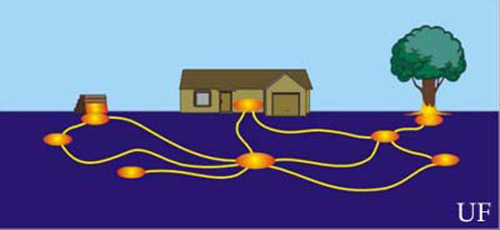
(Graphic by Nan-Yao Su, University of Florida).
FAQ-What’s the difference between flying ants and termites?
Swarming termites, called alates, are often mistaken for winged ants. Both are dark brown and about a half-inch long, but there are distinctive differences. Alates have straight antennae; ant antennae are bent or elbowed. Termite bodies are broad-waisted; ants’ are pinched. Both insects sport two pairs of smoke-colored wings, but termite wings are all of equal length and noticeably veined. In ants, the rear pair of wings is shorter and there are fewer veins.
When swarming alates land, they quickly shed their wings, seek a mate and go to ground, digging an initial chamber in which to begin a new colony. Often, said Todd Veden, a technical specialist with the pest control company Terminix, the only evidence of alates are those discarded wings. “In these cases, you look to see if there is a mix of sizes or if they’re all the same length” to determine if the wings came from ants or termites.
FAQ-How much does termite treatment cost?
FAQ-Can you hear termites in the wall?
Answer … … …
… … … …
YES.
And! Termites never sleep. They constantly do their job 24 hours a day. (Also a fact to keep in mind re: nonstop consumption & destrction).
FAQ-What kills termites?
If you’re asking this question, it’s possible this isn’t your first rodeo with the large “swarm’ (pun intended) of search results typically returned when you type this question into a search engine. As with most things, suggestions on how to call “curtains” on termite colonies or home infestations are generated by a wide variety of content creators, ranging from professional termite companies to “do-it-yourself” (DIY) group posts and blog entries.
Methods offered by DIY sites can include use of vinegar, boric acid, or a type of burrowing parasitic worm referred to as nematodes as a natural means to send termites packing. But most pest control professionals agree, there’s nothing that can kill or eradicate termites naturally – or at least not fast enough to truly combat continually growing termite nests and the worker termites that view your exposed beams as breakfast, lunch, and dinner.
So, what do the pest control professionals suggest? For starters, avoiding an infestation altogether by enlisting a company to perform regular preventative treatments (that don’t call for vinegar or boric acid).
But specifcally, there are two main chemicals used to kill termites — fipronil and hexaflumuron.
________________________________


